WELCOME

Welcome to my Blog.......The best tips on net for tennis. Click here, if VISITING FOR THE FIRST TIME.
Also dont forget to visit my new website WWW.BHARATVERMA.IN


Support Us

Monday, July 06, 2009

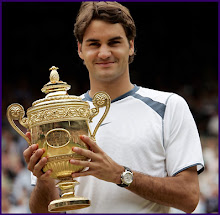
Roger Federer Wins Wimbledon Final agianst Andy Roddick.


Roger Federer beats Andy Roddick to wins his carer 15th Grand slam title and became the only person to do so. He won the match 5-7,7-6,7-6,3-6,16-14 (yeah right 16-14) to win his 15th grand slam beating Andy Roddick in a hard fough match that saw no favorites in front of greats like Borg & Pete samprass. Federer also reclaimed the world number 1 ranking after wining his 15th title.

Wednesday, July 01, 2009

Stop Thinking About Winning

By John F. Murray, Ph.D

James BlakeWouldn't it be grand if there were a special world where every player won every match? In this tennis fantasyland, scores would be meaningless since every player would be crowned champion. If this is what you seek, hit the snooze button one more time. When you wake up and smell the Starbucks again, you'll remember that every player eventually loses except the tournament winner. In fact, without the risk of losing, your dream would be so boring it would keep you asleep! The challenge and uncertainty in tennis provides much of the thrill and an obsession with winning only hastens defeat.

Too much emphasis is wrongly placed on winning. This does not mean not wanting to win far from it. That is why we play sports. But remember that there is also an opponent and that the most control we really ever have in a match over outcome is 50%. 50% is just as good as zero since there is never more than half control.

When NY Yankees owner George Steinbrenner gave Joe Torre the ultimatum, “win against Cleveland or you are out,” media scurried to cover the “bad boss” element. I made the point that saying “win or you are fired” is the same as saying “flap your arms and fly or you are fired!” Nobody can control winning, but everybody can control performance, and that is where the focus needs to remain.

Task-involved athletes focus on performance and display high intrinsic motivation, produce maximal effort, and persist longer across a variety of situations. Players emphasizing performance goals (e.g., higher percentage of first serves) over outcome goals (e. g., winning) retain more attention for the immediate task at hand. Getting wrapped up in thoughts about outcome only leads to distraction, anxiety, and pressure.

What you really want is to be sincerely fascinated with the many dimensions of performance. Staying excited about performance keeps you firmly in the present and guards against the loss of self-confidence that could occur when the next Rafael Nadal or Justine Henin rolls into your upcoming tournament.

Take a few seconds to recall the best performance of your life. You may not remember the details well because you were so completely absorbed in the moment. Expending energy dwelling on past mistakes or possible outcomes would have only spoiled this peak experience. Your focus on performance that day was admirable and winning took care of itself. This is where you want to be every match.

One way to remain focused on performance is to set short-term goals. These should include daily, weekly, and monthly goals. Start by investing in a small notebook or computer blog site which should be used to keep track of goals, achievements and comments. A rule of thumb is to set goals that you can achieve about 55% of the time. If you are reaching your goals more than 65% of the time set greater challenges. If you achieve your goals less than 45% of the time set them easier.

Make sure that your performance goals are specific, challenging, and realistic. Here are some examples of viable performance goals in tennis:

1. Increase your net approaches by 10 each set.
2. Increase your first service percentage from 55% to 70%.
3. Replace every on-court negative self-statement with a positive comment.
4. Lob the ball at least 50% of the time when in serious trouble.
5. Reduce your unforced errors by 5 per set.

Remember to set mental as well as physical performance goals. Self-knowledge is the key to setting intelligent goals. As you notice improvements in performance, don't be surprised if your opponents begin losing a little more often.

So stop flapping your arms to fly. Your best chance of flying is to focus first on performing.

Monday, June 29, 2009

Rafael Nadal's Backhand

By Paul Annacone
Photograph by Thomas Coex/AFP/Getty Images

Rafael Nadal

1. Core
Nadal’s bulging biceps and calf muscles get the most attention, but it’s his midsection that makes all his strokes, and especially this stretched-out, open-stance backhand on clay, so phenomenal. Any other player attempting to hit a ball this far from his body, with such a wide stance, would lunge forward and lose most of his power. Nadal has excellent posture, balance and overall body control. Few players have enough strength in their abs to hit such an offensive shot from such a defensive position.


2. Shoulders
Even though he’s facing the net and stretched to his limit, Nadal turns his shoulders and uncoils into the shot. This is a key point for club players: The open-stance backhand isn’t a license to do away with a standard shoulder turn. Without it, you can’t hit an effective shot.


3. Hands
Though he plays left-handed, Nadal is naturally a righty, so it’s no surprise that his right hand does much of the work on this shot. When you try your next two-hander, pay attention to your off hand. It can give you more control and power to drive the ball. Don’t let it just go along for the ride.


4. Feet
Nadal slides into this stroke and stops at the perfect time. Many club players either can’t slide on clay, or, if they can, they slide too far; Nadal has perfected the art. He comes to a stop, transfers his weight into the shot, and then his trailing leg slides along to the ready position without sending him any farther from the center of the court. He might look rugged and violent out there, but, as this image shows, Nadal moves economically and precisely. On clay, no one does it better.


5. Thighs
Do you cringe when your pro tells you to get down lower for your shots? Nadal shows how it’s done. He has enough flex in his knees to sit in a chair. His center of gravity is low and he pushes through the shot from the ground up.

Thursday, June 25, 2009

Target your Heart Rate.

By Sarah Unke

To get the most out of a cardio workout, you need to get your heart rate into your target heart rate zone. However you keep your heart rate elevated—by running, doing intervals on an elliptical machine, on taking a spinning class—the American Heart Association recommends that you do “moderately intense aerobic exercise” for at least 30 minutes most days of the week.

Venus Williams
Rebecca Naden-pa/AP Photo
Venus Williams gets her share of target heart-rate training on court.
So how do you know if your workout is moderately intense? Calculate your target heart rate zone and work to stay in the middle of that zone while you’re doing your cardio.

Here’s how you do it: According to the American Heart Association, a person’s target heart rate is 60–80 percent of his or her maximum heart rate. To find your maximum heart rate, subtract your age from 220. So, take a 35-year-old, for example. His or her maximum heart rate is 220 minus 35, so 185 beats per minute (bpm). That’s the maximum rate he should reach while exerting himself. The target heart rate zone, or where he should try to keep his heart rate for the most safe and effective cardio workout, is 60–85 percent of the maximum, so 111–157 bpm.

A heart rate monitor is the most convenient way to keep track of where your heart rate is during a workout. But you can also do it the old-fashioned way by checking your pulse. Just count how many times your heart beats in 10 seconds at your wrist or neck and multiply that number by 6 to get your beats per minute. That way you can tell whether you need to pick up your intensity, dial it back, or stay right where you are.

Tuesday, June 23, 2009

Pick the right doubles partner

It used to be said that the best doubles team in the world was John McEnroe and anybody else. While we can’t all play alongside a ringer, we do have some say in our selection of a partner, and that’s the first step toward playing good doubles. I feel that the best doubles sidekick is one who complements you. For example, if you’re an extrovert, try to find a more introverted partner. Or vice versa. Your differences in personality will even out your moods on the court and prevent you from getting too excited or too withdrawn. But this doesn’t just apply to your personalities. Combining players with different playing styles—for example, a steady player with a flashier one, or a right-hander with a lefthander— also works well.

Angel Lopez, USPTA Master Pro
San Diego Tennis and Racquet Club, San Diego, Calif.

Sunday, June 21, 2009

Novak Djokovic's Kick Serve

How the Serb hits one of the nastiest kickers in the game.

By Paul Annacone
Photos by Manuela Davies/Double Exposure

Novak Djokovic

1 For many club players, the toss is the biggest challenge on a kick serve. It must be to your left (if you are righthanded, like Djokovic) and slightly farther back than it is on a flat serve, so you can brush up on the ball to create topspin. Djokovic extends his tossing arm fully, keeps his eyes on the ball, and relaxes his knees. I also like his grip, a bevel turn to the left of the Continental so it’s easier to impart spin (for more on grips, go to TENNIS.com/grips). Another note: Djokovic’s hitting arm lags behind his tossing arm. I wouldn’t recommend this technique for beginners. Club players will have more success if they bring their hitting and tossing arms up together.

It takes impeccable timing to let the hitting arm lag behind the tossing arm, as Djokovic does here. You're better off bringing up both arms together.
2 It’s easy to see why Djokovic generates such spin and pace on his kick serve: He’s almost elastic in his wind-up. He coils so much that his back partially faces the net. Djokovic’s racquet and hitting arm both point upward, but notice the angle of his shoulders, which slope downward. His hitting arm is lower than his tossing arm, leaving room for him to extend up to the ball and rotate fully, increasing the speed of his racquet along the way. Djokovic’s knee bend is now deeper and his feet no longer rest flat on the court.
3 Here Djokovic begins to accelerate up to the ball. He drops his racquet head, straightens his knees, and starts to uncoil. Club players can learn a lot about balance and timing from this photo. As Djokovic pushes off with his feet, his shoulders begin to open, but not too quickly—he doesn’t fall into the court. Notice that his tossing arm comes down; otherwise, it would block him from rotating his shoulders.

Djokovic's chest points up toward the ball as he drops his racquet and begins to uncoil.

Novak Djokovic

4 Like all great servers, Djokovic drops his racquet to the point where the top of the frame points at the ground (you can see it just below his left arm). His hitting elbow points up as the ball comes into view, slightly in front of him and to the left of his hitting shoulder. His feet are off the ground and his energy is directed up and forward, which will allow him to brush up the back of the ball and propel it into the court with pace.

If Djokovic were to let this ball drop, it would brush the side of his head. This is where the ball needs to be for the up-and-out motion required for a kick serve.
5 When you hit a kick serve, your racquet must brush up and over the ball from the 8 o’clock position to the 2 o’clock position (for lefties, it’s 4 o’clock to 10 o’clock). This photo shows Djokovic right after contact, and you can trace the upward arc of his swing path. His hitting shoulder and arm, which started out low in the second picture, are now fully extended, and his shoulders have rotated almost 180 degrees.
6 Djokovic’s momentum carries him well inside the court. His back leg extends outward for balance, while his chest is parallel to the ground. The the most important thing to learn from this sequence is that hitting a kick serve doesn’t just require brushing up on the ball. You must hit out, too. That’s what makes Djokovic’s kicker one of the best in the game.

Djokovic's back leg kicks out for balance as he lands on his left foot.

Sunday, May 24, 2009

A New Footwork Manifesto

Much of what you’ve heard about moving on a tennis court is wrong. Here are the real keys to footwork in the modern game.

By Jose Higueras(Tennis Magazine)

Andy MurrayHow many times have you heard the following phrases: “don’t give any ground”; “always move forward for the ball”; “don’t hit off your back foot”? In the United States, “hug the baseline” and “take the ball on the rise” have become self-evident truths; to play well, you must play it this way.

This is a myth. If you want proof, look at the pro game. The world’s best players frequently hit the ball while leaning backward, not into the court, or while retreating from the baseline. The pros don’t do this because of nerves or bad technique, but out of necessity. As Rafael Nadal, who might have the best feet in the world, explained when a reporter asked him why he spent so much time well behind the baseline against Fernando Verdasco in the Australian Open semifinals, “Did you see the speed of the ball or not?”

Nadal points out a simple fact about footwork in today’s modern, baseline-oriented game: You can’t fight the ball. If it’s coming slowly, move in and take the offensive. But if it’s coming quickly, you need to adjust. Imagine you’re standing in the middle of a circle, ready to react to the ball from 4 feet behind the baseline. You have four obvious choices—forward, left, right or back—along with all the directions in between. In other words, footwork is a 360-degree skill. It requires reading the ball immediately and taking the most efficient path to the ball. This is what I’m teaching students right now as the USTA’s director of coaching for elite player development, because it’s essential for players to learn these skills as early as possible. Here are four pointers and a drill that will help you dramatically improve your footwork.

Roger Federer1. Take pride in defense
If someone throws a hard punch at your nose, should you step forward and absorb the full force of the blow, or lean back, minimize the impact and throw your own punch? The answer is obvious, yet too few people apply the principle to tennis. If someone drills a ball close to the baseline, don’t try to cut the ball off at a sharp angle. Move back diagonally, make sure you’re balanced, and try to get the ball back deep. As much as we think of Roger Federer as the ultimate offensive player, his defense and positioning are what allow him so many opportunities to hit offensive shots. Tennis is a game of errors, even for the pros; if you make fewer of them than your opponent, you’ll win more often than you’ll lose. That said, let me emphasize that “defense” and “pushing” are not the same thing. Playing defense doesn’t mean being passive.

2. Think balance, not weight transfer
If you can arrive at the ball early enough to step into your shots, by all means do it. But at some point, you’re going to have to hit a ball off your back foot, with a slightly more open stance than you would like, or with your feet farther apart than you want. No one adjusts his movement like this better than Andy Murray. Fortunately, changing your technique on the fly is easier than ever today, thanks to lighter racquets that have larger sweet spots and better stability. The key to success on a shot like this is maintaining your balance. Keep your center of gravity low as you move and don’t slump your shoulders or bend over at the waist.

Jelena Jankovic3. Use large steps if needed
It’s generally good advice to take many small steps, rather than a few large ones, when approaching the ball. But follow it only when it’s practical to do so. Sometimes you have no choice but to take a big step, as Jelena Jankovic does here, and put the best swing you can on the ball. If you have to run a long distance, it’s OK to take bigger strides at first, and if you have time, shorten them as you near the ball so you can be more precise with your positioning. Many times, I find that players take too many steps when only a few are needed. This causes just as many problems—bad timing, weak strokes, errors—as taking too few steps. You want to move decisively (see the ball, react to the ball) and economically.

Andre Agassi4. Find your own middle
You’ve been told to return to the middle of the court after every shot. It’s better to learn where your neutral position is and return there. For most, neutral means favoring the forehand side; righties would stand 2 to 3 feet to the left of the center hash mark, like Andre Agassi does here. Others prefer to hit more backhands. Either way, move to a spot that allows you to use your weapon as often as possible. If your strokes are equally strong on both sides, but you move better to the right or left, leave more room on your faster side. Footwork isn’t just about moving to the ball. It involves orienting the court in a way that forces your opponent to place the ball where you would prefer to hit it. Use your positioning on the court to influence where your opponent hits the ball. If you simply go back to the middle after every shot and ignore your strengths, you’ll put yourself at a disadvantage.

Drill: Scramble
I run this drill with our USTA players. Stand facing the net behind the baseline in the ready position. Your practice partner should stand a few feet in front of you, facing you. When your partner tosses a ball—either to your backhand or forehand, and at varying depths—run after it and hit your normal stroke. From this close range, a partner can force you to hit many shots in a few seconds, and also make you move in various directions. As you improve, ask your partner to speed up the drill and toss balls to more difficult spots on the court. It won’t be long before you find yourself reacting to the ball more quickly and making better decisions.

Monday, January 12, 2009

Be your own court Trainer

Come to your own rescue with these treatments for common on-court injuries.

By Dana Sullivan

Even a minor injury like a blister can be a major problem on the court. But keeping a few basic first-aid supplies in your racquet bag and knowing how to treat some typical on-court injuries will keep you in the game, or at least get you back on court quickly. Here’s a look at some familiar scenarios, and how to treat them a.s.a.p., with advice from Dr. Christopher Van Tilburg, M.D., editor of Wilderness Medicine magazine and an avid tennis player.

First Aid FixesThe injury: Blister
How to treat it: “The sooner you can catch a blister, the better chance you have to prevent it from turning into a three-weeklong annoyance,” says Van Tilburg, who works at Providence Hood River Memorial Hospital Mountain Clinic in Oregon. If the blister develops while you’re playing and you don’t want to stop, cover it with a thin layer of first-aid tape (Band-Aids probably won’t stay in place during play and thick material can bunch up and cause friction that can lead to more blisters). If the blister is on your hand, you might have to wrap the tape around your wrist to keep it in place.

“Never pop a blister,” Van Tilburg says. The fluid inside has immune cells that help with healing, he explains, so opening the blister slows that process. You also risk introducing bacteria that could lead to infection. If the bubble bursts on its own, clean it as described in the following section on scrapes and cuts. For the next few days, leave the blister exposed to air as much as possible. If the blister is on your foot and you need to wear shoes, cover it with a piece of moleskin or a special blister bandage like GlacierGel Blister and Burn Dressings, which are waterproof bandages that have a layer of cooling gel. And while you may have heard that duct tape can be used as a blister bandage, Van Tilburg advises against this remedy because the tape isn’t hypoallergenic and could ultimately cause more irritation than the blister itself.

The injury: Scrape or cut
How to treat it: On a scrape, squirt a solution of baby shampoo mixed with water, making sure to rinse out any debris. “We use baby shampoo in the ER because it doesn’t sting and does a good job of cleaning
surface wounds,” Van Tilburg says. Next, add a layer of antibiotic ointment and, if the scrape is bleeding, cover it with a bandage or a piece of sterile gauze and first-aid tape.

For a cut, stop the bleeding by placing clean gauze or a cloth over the wound and applying direct pressure. If the bleeding won’t stop, the cut may need to be closed with stitches or a type of “super glue” that seals cuts. If the bleeding has stopped, treat the cut as you would an abrasion, but use a sterile saline solution to clean it since there’s more risk of infection with a deeper cut. Then cover it with a butterfly bandage or gauze and first-aid tape. After you’re done playing, leave the wound open to speed healing. Even surface wounds can get infected, so if the area becomes red, warm to the touch, and swollen after 24 to 72 hours, see your doctor because you might need antibiotics. Slather the area with sunscreen when you’re outside for two to three months after. “Scrapes scar really easily,” Van Tilburg says. “Using sunscreen diligently will prevent a permanent reminder.”

The injury: Sprained ankle, knee or wrist
How to treat it: Break open an ice pack and hold it on the injured joint for 10–15 minutes. Next, wrap the injured area in an ACE bandage, making the bandage snug, but not so tight that it cuts off circulation. Finally, elevate your leg or arm so it’s above your heart for another 15 minutes. (The acronym for these four steps is RICE: Rest, Ice, Compression and Elevation.) If there is significant swelling, if you heard a pop or crack, or you cannot move the joint normally after 15 minutes of rest, see a physician within 24 hours since you may have a more severe injury. “If you ignore a minor fracture it can become major, possibly even requiring surgery,” Van Tilburg says.

Tuesday, July 08, 2008

Roger Federer's Forehand

Roger Federer’s forehand is the most beautiful, versatile, and powerful weapon in pro tennis. It may also be the most misunderstood. We’ll dissect four major elements of this superb stroke.

By John Yandell

1. GRIP
Many people think Roger Federer plays with a semi-Western grip, similar to Andy Roddick’s. In reality, his grip is closer to Pete Sampras’. Federer keeps part of his hand off the end of the grip, but most of it is still on the back of the handle, directly aligned with the face of the racquet. He shifts his index base knuckle slightly downward about half a bev
Gripel toward a semi-Western grip (to do this, stand the racquet on its end, as in the diagram below, and place your index base knuckle between bevels 3 and 4 if you’re right-handed or between 6 and 7 if you’re a lefty). This modifi ed Eastern grip is more conservative than that of most top players, who typically shift farther toward the Western grip and place part or most of their hands under the handle. This grip allows for the ideal contact height for a player who stands close to the baseline and plays the ball early, a key to Federer’s effectiveness.

2. STANCE & TORSO ROTATION
One might expect that with his grip, Federer would hit in the classical style—that he’d use a neutral stance, step directly into the line of a shot, and swing with less torso rotation. Players with traditional grips of old, like Rod Laver and Ken Rosewall, typically rotated their torsos less and fi nished with their hitting shoulders almost parallel to the baseline. Federer can do this (see above), but usually he doesn’t. Instead, like the more extreme-grip players of today, he routinely hits from semi-open and open stances, rotates his torso radically, and finishes with his racquet shoulder facing his opponent.
Roger Federer Forehand

The semi-open and open stances allow Federer’s body to rotate fully without being blocked by his front leg. Yet his grip gives him versatility—the option to hit comfortably from a traditional stance with less rotation—that most extreme-grip players lack. Players with Western grips typically rotate their torsos much farther forward just to get the racquet head through the stroke. They would fi nd it awkward to step into the ball, because their front legs would block the forward swing.

Federer has synthesized elements of classical and modern technique. He fi nishes with as much body rotation on his forehand as players like Roddick and Rafael Nadal. Yet his grip makes him more comfortable than they are standing closer to the baseline and hitting the ball on the rise.

3. EXTENSIONRoger Federer
Many observers have noted how Federer finishes across his body, with his hitting arm and racquet wrapped around his torso at the end of the follow-through. What’s usually overlooked is how far out in front of his body he swings before bringing the racquet across. When Federer drives the ball, the length of his swing toward his target equals or exceeds that of virtually any player in the game. This is one source of his effortless power.

Federer’s extension happens so quickly that it’s difficult to see with the naked eye. In the photo below, Federer’s hand has reached about eye level, and his arm and racquet are almost completely straight, reaching out toward the target. Typically his hand is somewhere between shoulder and eye level. His hand and his torso are 2 feet apart, if not more. Federer reaches this point of maximum extension before the racquet starts to move downward and wrap around the side of his body. Most players who think they’re copying his motion use a wraparound follow-through but miss a critical element in not hitting completely through the ball first.

4. WIPER FINISH
Federer’s windshield wiper follow-through often confuses observers who associate this fi nish with more extreme grips. Federer turns his hand and racquet over during his follow-t
hrouRoger Federergh, fi nishing across his torso rather than over his left shoulder. The rotation in his arm can be as much as 180 degrees.

By combining a wiper fi nish and a classical grip, Federer can hit the ball hard and with a low trajectory over the net. But at the same time he can generate as much spin as almost anyone in tennis (see chart). There’s one more advantage to his use of the wiper fi nish: By varying how quickly he turns his hand over and the length of his extension, Federer creates a bewildering range of angles and spins, everything from crosscourt passes to precise topspin lobs. Because of his grip, he is able to do this while still hitting the ball early. Combining the extreme and classical components gives him a variety of options unequaled in the modern game.

LEARN FROM THE MASTER

How applicable are the elements of Federer’s forehand to the average player? In many ways, he’s a better model for club players than his rivals who play with all modern techniques. His grip is better suited to handle the majority of balls recreational players face. Club players aren’t forced to deal with the extreme high-bouncing shots you see in pro tennis. The natural contact point of most balls tends to be at around waist-level or a little higher, which is perfectly suited to an Eastern grip. This relatively conservative grip also alloRoger Federerws players to hit from numerous stances without the need for radical torso rotation.

Most important, Federer shows that by rotating the hand and racquet as a unit in the wiper motion, players can generate signifi cant spin and at the same time hit through the ball for depth and pace. Most club players should not use the wiper on every ball, but it can add spin, short angles, and versatility. It’s a paradox: At the pro level, few players have the timing necessary to make a synthesis of classical and modern elements work together. But in club play, where the ball is slower and lower, this combination is a realistic option. Federer’s forehand is both a stroke of genius and a stroke for the masses.

Wednesday, June 04, 2008

4 Serve Rituals

enjoy ppl my first video tut (not mine but only posted here by me)

Do comment good or bad ...

Saturday, May 10, 2008

Put It on a Dime

By Nick Saviano
Photos By Lara Tomlin

In Line with Front ToeAll the speed and spin in the world won’t matter if you can’t place the serve where you want it. The ability to control the direction of the serve is a critical component to its overall success. Hitting an ace is great. But not everybody can consistently crank the speed needed to blow a ball by an opponent. What’s more important is to set up the point tactically. The advantage of being the server is that it gives you a chance to dictate the point from the start. With good control you can choose to do things such as serve your opponent out wide or play to his weaker side. Here are some things to keep in mind if you want to have total control over your serve.

PAY ATTENTION TO YOUR FRONT FOOT
To manipulate the placement of your serve, you must first have control over your balance. Many players blame a bad toss for problems with their service accuracy, but I think you should look at the feet first. If your front foot is moving around to accommodate an errant toss, you’re going to hit from an unstable base. It’s fine to drag your back foot up during your service motion, but that front foot, apart from turning slightly to assist your upper-body rotation, should stay where it is.

Do Not Let Your Foot WanderIn fact, most of the time your toss should be in line with your front big toe, give or take an inch or two. If you can consistently put the toss in that location, you’ll have a better opportunity to control your serve. The big mistake players make is changing the toss to help hit to a target. Obviously, if you’re hitting a kick serve, the toss will have to move more behind your head, but on your basic power first serve the toss needs to be more in line with your front foot, no matter what direction you’re aiming the ball in.

USE GOOD SHOULDER ROTATION
Not only does turning your shoulders add power to your shot, but it aids in accuracy as well. Too often recreational players simply face the net. This forces more of the power burden to fall on the serving arm, which can cause a loss of accuracy. The players who hit their locations most frequently generally have a healthy shoulder turn. This also provides good disguise during the preparation phase of the serve and will give your opponent trouble when he’s trying to
read where you’re aiming.Shoulder Rotation

PRACTICE HITTING TARGETS
There are three primary locations you are going to serve to—out wide, into your opponent’s body, and down the middle. While there are variations depending on the amount and type of spin you use, these are the crucial spots.

The best way to practice hitting these locations is to set up targets that cover a decent-sized area. Don’t limit yourself to a space the size of a tennis ball, because that’s unrealistic and would become too frustrating to try to hit. And avoid trying to crush the ball. Rather, focus on good rhythm, timing, toss, and location. Attempt to hit the same target no more than three to five times in a row. This will prevent you from altering your toss or service action in order to hit that spot. A fourth target to consider is a shorter angle on a wide slice serve. You can place it a couple of inches from the singles sideline and several feet up from the service line. This serve is great for pulling your opponent outside of the court and out of position.

Practice Hitting Targets
MOVE THE RETURNER AROUND
There are two locations to be concerned with on the serve—the spot where the ball lands, and, perhaps more important, where the opponent makes his return. For example, say you’re a right-handed player trying to hit the ball down the T in the deuce court. If you hit a serve with some slice (which curves from right to left), the ball may land near the T, but it will curve toward your opponent. It may still be a good shot, but a flatter serve that lands in the same spot will stay farther away from your opponent and potentially be a more difficult return.

On the other hand, if you’re a righty and serving from the deuce side, that same slice serve placed out wide will curve away from your opponent more than a flat serve hit to the same location will. So you have to experiment with your serves and spins to figure out the spots you need to hit to stretch or jam your opponents. Depending on the flight path of your serve you may have to start the ball directly at the target or slightly to one side to achieve the desired effect. That’s why placement and spin are just as important as pace when it comes to the success of your serve.

Move the Returner Around


PS : The shoes this girl is wearing in the pic is same as mine [:P]


Saturday, December 01, 2007

Returning Soft Shots

Q. I consider myself a solid 3.0 player. I love competing against other 3.0 and 3.5 level players and I do quite well. But when playing against what I would consider 2.5 level players, I usually end up losing the match. My problem is that I cannot seem to speed up their short slow balls. I return anything that comes my way slow with the same intensity that it comes in. If I take a good swing at it, all my shots go long. This has been going on for about six months! What is the best way to handle this situation? Obviously, I can push the ball back over the net all match long, but this does not change the pace, which is the outcome that I am looking for.
—John Kelly, Boston

A. Creating pace is difficult for many players because it requires polished technique to do it consistently. And it’s especially tricky to hit forcefully off really soft shots. You don’t say anything about your technique so I’ll address your situation in general terms.

First, here’s what not to do. Don’t try to hit too hard. Just as you don’t take your car from first gear right to fourth, you shouldn’t attempt to take your opponent’s soft shots and send them back twice as hard as they came to you. Instead, whenever your opponent gives you a soft shot send it back with a little more pace than it came with. This may not feel as satisfying as you’d like but it’s a mental adjustment that you have to make if you want to successfully handle these soft, short balls.

Get started by having a practice partner simulate the shots that give you trouble. There’s no substitute for hitting dozens of balls in a controlled environment. As you practice work on getting in position and preparing well. A full shoulder turn is critical if you want to create pace. (To ensure you’re turning your shoulders enough try this. Assuming you’re right-handed, if you’re hitting a forehand turn your upper body so that your left shoulder comes to your chin. For backhands your chin would rest on your right shoulder.) Since you say the balls you’re having trouble with are short and you have a tendency to hit long, you need to place a special emphasis on using extra topspin to keep the ball in the court. In fact, spin should be emphasized over power. Therefore, make sure you get your racquet below the intended point of impact as you’re swinging forward. That may mean using your legs to get lower than you normally do.

Finally, focus on placement. Sure it feels good to hit the ball hard, but winning shots are more about putting the ball in the right place than they are about being struck with great force. Generally, aim the ball toward your opponent’s weaker side and go for depth. If it lands closer to the baseline than to the service line you’re doing good.

—Tony Lance, Instruction Editor, TENNIS Magazine

Thursday, October 25, 2007

Tag-team tennis

By Pat Whitworth

The best doubles teams play as if they’re a tag-team wresting duo that tries whenever possible to turn points into two-on-one contests. The idea is to isolate and work over one of your opponents until you get the right ball to finish the point.

This does three things for you:

1) Allows you to hold your position on the court instead of following the ball around as you would if you hit to both of your opponents।

2) Gives your opponents fewer gaps to exploit, since your position doesn’t change much।

3) Reduces your errors, since many errors occur when you try to change the direction of the ball too early in a point।


Pat Whitworth is a USPTA Master Pro in Hamilton Mill, Dacula, Ga.

Monday, October 15, 2007

High backhand volleys made simple

High volleys should be easy, right? Then why do you miss so many on the backhand side? The problem is likely because of your backswing. Players miss volleys long because their backswing was too long and the ball got to their racquet before the racquet face got back forward. Players miss volleys into the net because their backswing was too long, they swung aggressively, and the racquet ended up too far forward.

The good news is that it’s really hard to miss a routine volley—especially a high volley—if you don't take too big a backswing. How do you know if your backswing’s not too big? If, when you take your racquet back, you can still see the back of your strings (the side the ball's not on) it's almost impossible to make a mistake on the volley. All you have to do is line your racquet face up with the ball and push forward on impact.


from the "tennis" mag.


Body Blow

If your opponent is still catching his breath after a long point, consider aiming your next serve directly at his body. A winded receiver will often play the return without taking adjustment steps, which are necessary for returning a body serve. Aiming the ball at your opponent in this situation will often result in a weak reply that allows you to play an aggressive shot on the next ball.


Kirk Anderson, USPTA & PTR Master Pro, New Fairfield, Conn.

Tuesday, October 02, 2007

Tag-team tennis

By Pat Whitworth

The best doubles teams play as if they’re a tag-team wresting duo that tries whenever possible to turn points into two-on-one contests. The idea is to isolate and work over one of your opponents until you get the right ball to finish the point.

This does three things for you:

1) Allows you to hold your position on the court instead of following the ball around as you would if you hit to both of your opponents।

2) Gives your opponents fewer gaps to exploit, since your position doesn’t change much।

3) Reduces your errors, since many errors occur when you try to change the direction of the ball too early in a point।


Pat Whitworth is a USPTA Master Pro in Hamilton Mill, Dacula, Ga.

Saturday, September 29, 2007

Two-Handed Backhand of Novak Djokovic


Extensive hip rotation and a composed upper body make this shot a dependable asset.


The great thing about Novak Djokovic’s game is how complete it is. He can do pretty much anything. And while his forehand is a punishing stroke, his backhand might be the more solid of the two shots. Djokovic can hit the ball crosscourt or open up the court with a shot down the line. It’s a big part of his constantly improving game.

Novak Djokovic

1. This is a classic preparatory position for a two-handed backhand. Djokovic is looking over his dominant shoulder to track the ball and has excellent balance and posture. His hands are slightly higher than his waist, with the racquet head above his wrists and pointed back and up at 2 o’clock. He’s behind the baseline, but Djokovic is giving himself ample opportunity to step into the shot.

2. Djokovic takes his racquet back by employing a full shoulder turn. It’s a fairly straight backswing with the racquet head up. It appears as though Djokovic is making a loop, but the position of his frame is a result of his full upper-body rotation. At this point, Djokovic plants his left foot and loads all his weight on it. He’s ready to start his forward swing.

3. Djokovic’s hands get more involved in the stroke as he raises them and increases his shoulder turn. He’s beginning to transfer his weight by stepping forward with his right foot, which is parallel to the baseline. (Ideally his foot would be at a 45-degree angle with the baseline to allow him to open up faster.) The thing to appreciate is the position of Djokovic’s hips. They’re fully rotated and coiled, and as the sequence continues he does a great job of releasing them into the shot.

4. As he gets ready to unleash on the ball, Djokovic points the butt cap of his racquet toward the other side of the net. He’s starting to drop his racquet head, but he’ll only get under the ball enough to give it a little bit of topspin. Djokovic is also pushing off the toes of his back foot and starting to open up his hips.

Novak Djokovic

5. Djokovic makes contact in front of his body and at waist level. Notice how his hands are moving away from his torso and working together; neither is dominating the other. His legs are straightening to lift his body up into the shot, and his hips and shoulders are opening up. Djokovic’s shoulders are more uneven than usual, but that could be a slight improvisation to compensate for the ball’s height and position.

6. There’s so much momentum created by his racquet acceleration, trunk rotation, and the weight shift in his legs that Djokovic is off the court when he follows through. Even though he’s in full swing, his head and body remain composed. Djokovic’s arms extend through the hitting zone as his hips open up. His belly button, which was pointing to the side in his backswing, now faces the net.

7. Both of Djokovic’s elbows are pointing away from his body as he follows through. All his weight is now on his front foot, and his left leg is starting to come around to aid in his recovery. Djokovic has kept his head down throughout the stroke; only now is he tracking his shot. Judging the ball’s flight path and his opponent’s reaction will give Djokovic a better idea of where to position himself for his next shot.

8. The ball has left the frame, but Djokovic is still completing his long follow-through. This is a great lesson for rec players—finish the swing first, then recover. Djokovic’s left leg is swinging out so he can plant it and move back toward the center of the court. He’s low to the ground, with his balance still perfect. That will help him explode to wherever the next ball goes.

Saturday, September 15, 2007

Keep your grip soft

Keep Your Grip SoftIs there any shot more impressive than a feathery drop volley hit off a driving ground stroke? To execute that difficult touch shot, you need “soft hands.” That’s just another way of saying you should use a relaxed grip. To get the feel for it, try the two-finger volley grip. Rather than holding your racquet like you normally do, grip the handle with only your ring and pinky fingers. Your other fingers should wrap around the grip, but don’t use them to squeeze. This encourages the relaxed, soft feel you need to make those eye-catching droppers and sharp-angle touch shots

Tuesday, September 11, 2007

The Forehand of Maria Sharapova

Early preparation and an attacking mind-set have helped the Russian turn this shot into a world-class weapon.

When Maria Sharapova stunned tennis fans by winning Wimbledon in 2004, her serve and backhand were her biggest assets. But in the last year, she has molded her forehand into a weapon as well. She’s more aggressive off that wing than ever before, and it’s the shot she relies on most to open up the court and construct points.

Maria Sharapova


1.
Sharapova uses her left hand to help take her racquet back and assist in her shoulder turn. See how her left shoulder comes up to her chin? I like that, because it indicates a full turn. Her balance is very good. She’s ready to move forward and take this shot just inside the baseline—clearly Sharapova is looking to attack. Her grip is almost a full Western.

2. Sharapova continues with her excellent shoulder turn. As she takes her racquet back, she’s making small adjustment steps that help put her in an ideal position. Sharapova’s racquet is back a little higher than I was taught to take mine—my backswing was more compact—but it helps her produce greater racquet-head speed, which means more power.

Maria Sharapova

3. Sharapova’s left hand is starting to move out in front of her to track the ball. Doing this helps ensure that her point of contact is out in front of her body. Her head is down and her eyes are right on the ball. At this point, it appears she might be preparing to hit an open-stance forehand, but she’s not; she’s putting her left foot directly in front of her right as she moves to the ball.

4. This photo screams balance and power. Sharapova is getting ready to unleash into the shot. Her head has barely moved since the fi rst frame, and her racquet is looping down out of her high backswing. The only criticism I have at this point is that her right elbow is too far away from her body. I prefer it to be in closer, which gives you more control. It appears she’s decided to take a backswing that’s bigger than usual so she can really attack the ball.

Maria Sharapova

5. Sharapova has pulled her elbow closer to her body. She’s dropped her racquet almost to its lowest point and she’ll bring it forward and up, hitting the ball from below and swinging up and through it. The racquet face is a bit closed, so she’ll generate some topspin. Sharapova’s upper body is already uncoiling, helping to move the racquet toward the contact point. Her weight is now on her front foot.

6. The point of contact is just where it should be—in front of the body. Sharapova has taken the ball early, hitting low to high, and her balance is excellent. Her eyes are locked on the ball and her weight is moving forward to the point where she’s come up on her right toe. It appears from her stance and the position of her shoulders that she’s going down the line with this attacking forehand.

Maria Sharapova

7. I like that Sharapova is hitting through the ball and fi nishing by taking her racquet across her body. She could have extended the frame even more through the path of the ball, but I think the fact that she didn’t is probably because she’s added topspin to this shot. Her forward and upward momentum have brought both of her feet off the ground. Notice how her head remains down. Even though she’s hit the ball, she’s not yet looking to see where it’s going.

8. his is a wraparound follow-through. Sharapova has a tendency to follow through on her forehand over her right shoulder instead of her left, particularly when she’s hitting off her back foot. But on this one she’s done it in the traditional way. She didn’t pop up too fast, so she’s balanced and ready to get back to the middle for the next shot.

Thursday, August 30, 2007

Cooling Down a Hot Opponent

Cooling Down an Opponent
Beginners should aim most of their shots toward
their opponent's weakest stroke, which is often the
backhand.

Trying to raise your game isn’t necessarily the best option when you face a player who’s giving you more than you can handle.


The first thing most players do when they find themselves trailing in a match is look for things that will help them raise their level of play. The problem with that strategy is that players typically start matches using their A game, so switching to something else usually means they end up using a tactic that’s the second- or third-best choice for their style of play. I’ve found that the smartest players react in a different way when they’re behind: Rather than trying to lift their own level, they focus on lowering their opponent’s. Here are some ways to win ugly.

BEGINNER

OBJECTIVE 1: Keep the ball in play.
When you’re just starting to play tennis, you can win many matches simply by being more consistent than your opponent. Mastering the concept of shot tolerance—knowing how many balls your opponent will hit before he feels he has to go for a winner—should be first on the todo list of all developing players. While shot tolerance varies from player to player, hitting three or four balls on a point is often all it takes to push a beginner out of his comfort zone and cause him to take a risk that, more often than not, will result in an error.

OBJECTIVE 2: Isolate and destroy
Isolation is the tactic of identifying and exploiting your opponent’s vulnerabilities. At the beginner level the most glaring weaknesses are often particular shots, such as the backhand or the volley. Once you identify the chinks in your opponent’s game, hit the majority of your shots to those soft spots. Making your opponent hit shots he’s uncomfortable with should bring down the rest of his game.

Cooling Down an Opponent
Use underspin to test your
opponent's timing and
technique.
INTERMEDIATE

OBJECTIVE 1: Master the moonball
While many intermediate players know how to play aggressively from the baseline, few have learned the skills needed to attack when given a steady diet of high, looping balls with plenty of topspin—aka the dreaded moonball. These difficult-to-handle shots force your opponent to move back from the base-line, giving him fewer angles and less pace to work with. Consequently, moonballs often lower your opponent’s level of play by depriving him of the opportunity to attack while simultaneously forcing him to be more patient than he might like to be.

OBJECTIVE 2: Use slice and underspin
Have you ever seen someone come off the court bragging about how well he played against a guy who sliced and diced? I haven’t either. The fact is, most players absolutely hate to compete against opponents who hit a lot of junk. Why? Slice and under-spin shots are not as easy to handle as they appear. Sure, they look like they would be easy to attack, but because they bounce lower and slower than topspin shots, slices take you out of your rhythm. Hitting aggressively against these shots requires well-grooved technique and excellent timing, abilities most intermediates don’t have. Changing spins is one of the most effective ways to lower your opponent’s level of play.

Cooling Down Your Opponent
Drop shots can lure advanced players into
the forecourt on your terms.
ADVANCED

OBJECTIVE 1: Serve to the weaker side
It’s not uncommon for advanced players to have a 5.0 forehand and a 4.0 backhand. Discovering whether this is true for your opponent will give you a huge advantage. Think about it: If you pay attention and hit your serves to your opponent’s weaker return side, you can deter-mine if you’re going to be playing a 5.0 player or a 4.0 player as you start each point in your service game. The last thing you want to do when you’re trailing in a match is to give your opponent an opportunity to hit his best shot.

OBJECTIVE 2: Develop a drop shot
This may seem like a tactic best suited for a lower level of play, but remember that most advanced play-ers prefer to hit from the baseline. If you can make your opponent come to net on your terms, you can force him to beat you from a part of the court where he’s uncomfortable. Re-member to use the drop shot to get your opponent off the baseline, not to try to end the point outright. If a winner is your goal, the drop shot is not the best choice.