WELCOME

Welcome to my Blog.......The best tips on net for tennis. Click here, if VISITING FOR THE FIRST TIME.
Also dont forget to visit my new website WWW.BHARATVERMA.IN


Support Us

Showing posts with label Extras. Show all posts

Thursday, July 12, 2007

Andy Roddicks Serve

Monday, July 09, 2007

High Five: Federer ties Borg with Wimbledon win

By Kamakshi Tandon

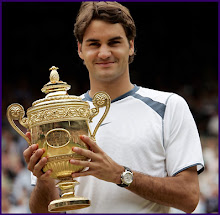
Roger Federer
Roger Federer won his 5th consecutive Wimbledon title as the weather finally turned bright and clear during the final weekend of the Championships.

© Clive Brunskill/Getty Images
Wimbledon began with rainy and ragged weather, but it finished with a day of sunshine that bathed the men’s final in a glow never possible until this year’s roofless Centre Court opened the stadium to the skies.

The tennis also shone, a five-set battle between Roger Federer and Rafael Nadal that turned Federer’s way just when it looked as if the title might be slipping from his grasp.

He won the last four games to close out the match 7-6(7), 4-6, 7-6(3), 2-6, 6-2, falling to his knees in trademark style before collapsing onto his back in relief. The victory gives Federer his fifth consecutive Wimbledon title, tying him with Bjorn Borg as the only player to achieve the feat in the Open Era.

Federer also tied Borg's (and Rod Laver's) mark of 11 Grand Slam titles, putting him behind only Roy Emerson (12) and Pete Sampras (14) in the all-time list of men’s champions. At 25, he hopes he has time to move up the list. “Obviously it’s on my mind,” he said. “I don’t know how much longer I can keep it up, but I definitely feel like I’m mentally and physically still fit to go on for many more years to come.”

Borg made a rare appearance at Wimbledon to watch Federer equal his record. The two spoke afterwards in front of the champions’ honor roll, where both their names are carved so many times.

Several other legends were also present for the final, and the Swiss world No. 1 looked like a vintage presence himself during the trophy ceremony, wearing a white jacket and long pants. “It was a huge occasion for me, huge pressure – “Bjorn Borg sitting there, Jimmy Connors sitting there, John McEnroe sitting there, Boris Becker sitting there,” said Federer.

With his latest win, he’s on his way to eclipsing them all. The only significant hole in Federer’s record is the French Open, where Nadal has ruled for the last three years.

Federer wasn’t the only one trying to match Borg on Sunday – Nadal was attempting to become the first player to win the French Open and Wimbledon back-to-back since the Swede did it in 1978. Appropriately enough, sitting beside Borg in the Royal Box was Manuel Santana, the only Spanish men’s champion at Wimbledon so far.

But the 21-year-old Nadal drew comfort from coming ever closer to winning the title he says he covets above all others. Federer and Nadal have now played the French Open and Wimbledon finals back-to-back for two years running, but Nadal can say he has come closer to toppling Federer on his turf at SW19 than Federer has against Nadal on Parisian clay.

“I play very good level, playing against one of the best in history in this surface... I’m playing at a similar level,” said Nadal.

The two had taken very different paths to get to the final – not least in the time spent on court. Nadal had played almost six more hours coming into the match, including two five-setters early in the week when the tournament was playing catch-up because of rain. Federer, meanwhile, had received a five-day break in between thanks to the weather and the injury withdrawal of his fourth-round opponent Tommy Haas

Nadal still managed to push Federer to five sets – the first time that’s ever happened in a Grand Slam final – and the world No. 1 knows his younger rival presents a growing challenge. “I’m happy with every one I get now, before he takes over,” Federer told the Centre Court crowd.

For Nadal, it's the first time he's lost in a deciding fifth set in over two years. But he too spoke about his opponent with typical graciousness. Talking about Federer’s quest to top the Grand Slam list, Nadal said, “[Whether] he going to win 14 or 16 or 13, in my opinion [his] tennis level is the best of the history.”

The mutual praise was a pleasing epilogue to a hard-fought and draining match that had given both players reason to believe they might triumph. "Maybe if we have to find any difference, maybe the difference is the serve," said Nadal when asked what had determined the outcome. "He serve better than me and that's important in every surface, but in this surface more."

Rafael Nadal
Rafael Nadal, trying to become only the second Spanish man to win Wimbledon, had four chances to go up a break up in the fifth set.

© Chris Young/AFP Getty
Federer agreed. "From the baseline... I always thought he had the upper hand for some reason and I couldn't really play that agressive like I wanted," he said. "But my serve kept me in, and I definitely won the big points today, which was most important."

The first set was decided in a tiebreak that mirrored the rest of the set – Federer beginning with an early lead and Nadal coming back; brilliant play slowly giving way to more nervy errors.

The second set appeared to be chugging steadily to another tiebreak conclusion when, without warning Nadal found a set point at 4-5 and leveled the match with a superb backhand pass down the line.

Both players lifted their level in the third, but Federer managed to deliver the first strike often enough during the tiebreak to nose ahead. But it was Nadal who struck first in the fourth, finding winners from all over and breaking Federer twice to go up 3-0.

While securing his second break, Nadal left Federer visibly rattled when he used Hawk-Eye to successfully challenge a call. Earlier, a Hawk-Eye challenge from the Spaniard had overturned a point that would have won Federer the first set.

“How could that ball be in?” Federer plaintively asked the umpire during the changeover. The normally-unflappable Swiss was so disgruntled with the system that he wanted it turned off. “It’s killing me,” he told the chair.

Afterwards, he admitted that the emotion of the match had got to him. “I was just frustrated because already I got broken first up and then to be broken this way was for me very irritating,” he said. “So it took me a few games to kind of forget about it and I was ready for the fifth, thank God.”

Nadal called the trainer mid-way through the fourth set for treatment on his right knee. He did not appear to be unduly hampered, however, closing out the fourth set and twice going up double break point early in the fifth. After managing to hold both times, Federer suddenly lifted his game as if the reprieve had given him release.

“It was a tough moment to be in. I was nervous,” said Federer. “But I served well and played smart, took the right decisions.

”I was so happy when I came out of it because I knew that now he probably missed his chance. If I get one [now], I’ll probably make it. That’s exactly what happened.”

Nadal also felt he had blown his opportunity. “I know if I have the break in the fifth I have very good chances for have the title,” said Nadal, who until then had not been broken since his first service game of the match.

Instead it was Federer who stood the victor after three hours and 45 minutes. He improved his record against Nadal to 5-8, and has now won four of their last six matches.

Standing on court afterwards, he found one more reason to relish this year’s victory at Wimbledon. “It’s the only one without a roof, so I’m glad I took it,” he said, clutching the trophy as it gleamed in the sunlight.

Sunday, February 11, 2007

Handling a Grudge Match

Grudge MatchYou're enmeshed in a tight match with the hotshot at your club. As the contest progresses your opponent begins to irritate you. Perhaps the way he swaggers after making a good shot grates on your nerves. Or his calls are a little too quick and there's a smug, pleased tone to his voice as he yells, "Out!" In your mind, you have to win because you can't imagine having to smile and shake his hand if he beats you. In short, it's personal now. The problem is, when this happens you usually stop playing well. Here's how you can avoid this trap.

Forewarned is forearmed

The best time to focus on keeping personal feelings out of a match is before it starts. Recognize that it's counterproductive to let a match become personal, and resolve in advance to prevent this from happening. Tennis is, by its one-on-one nature, an antagonistic sport. If unchecked, competition calls forth our natural aggressive responses. Unlike boxing or football, where anger can be rewarded, tennis requires fine motor control, which is compromised when a player begins to focus on his opponent rather than the game.

Assume that your opponent has personal idiosyncrasies

This will make you less likely to take umbrage at any of his actions on court. Realize that your opponents, like you, have their own ways of walking, making calls, and hitting good shots. They may make careless remarks in the heat of battle, and they have plenty of insecurities that have nothing to do with you. Keep this in mind so your own anxieties don't turn your opponent's actions into personal issues. That's right--it's your insecurities that make you overly sensitive to your opponent's mannerisms.

Winning or losing this match won't change your life

If you sense yourself yielding to temptation and becoming more tense and antagonistic than usual, picture yourself walking up to the net after having lost the match, shaking your opponent's hand, and congratulating him--with no tragedy ensuing. Here you accept the possibility of loss and recognize that no hugely negative consequence will result. Of course you'll be happier if you win, and you should continue to make your most strenuous efforts toward victory, but realizing that losing won't kill you--that the worst outcome is still bearable--is practical and emotionally balancing.

Approach this tennis match like it's a day at the office

Keep your focus on your side of the net. Try to look at the match as a set of physical and mental problems that you need to solve. And, as in the office, problems are best worked out objectively and rationally. Your opponent is like the net on the court, just another element of the game that makes the whole process possible. Making it an emotional struggle will cloud your judgment. You'll render yourself blind to subtle weaknesses (or maybe even glaring ones) in your opponent's game, your hands will stiffen, and your concentration will scatter.

Tuesday, January 16, 2007

Lessons from Isaac Newton

Learning from Isaac Newton
A split-step keeps you in continuous motion during a rally.


You may have done your best to forget high school physics class, but perhaps you remember one of the key physicists, Isaac Newton, and the three laws that were named after him. What do they have to do with your tennis game, you ask? Everything. When it comes to mastering important concepts and understanding your coach’s advice, many players grasp them better once they know the science behind it. So for the more cerebral players out there, this one’s for you.

BEGINNER

OBJECTIVE 1: Perform a split-step
Newton’s first law states that objects in motion tend to stay in motion, and objects at rest tend to stay at rest unless acted upon by an outside force. So if you’re flatfooted on court—an object at rest—it takes more effort and time to get moving and into position to return the shot. If, on the other hand, you perform a split-step (a small hop where you land on the balls of both feet) as your opponent makes contact with the ball, you’re an object in motion. This means you’ve already overcome your inertia and therefore can move to the ball faster. That’s why you always see good players do a split-step right before their opponentsmake contact with the ball.


OBJECTIVE 2: Strengthen your leg muscles
Stopping and changing direction— overcoming the inertia of your body in motion— takes a tremendous amount of leg strength, and the more powerful your legs are, the more agile you’ll be. Plus, you’re less likely to get injured if your leg muscles are strong enough to withstand the stress that tennis places upon them. So make time to train your leg muscles. Squats and lunges are particularly good exercises to make you explosive around the court.


Learning from Isaac Newton
A smooth low-to-high swing enables you to hit hard and keep the ball in the court.

INTERMEDIATE

OBJECTIVE 1: Get the right racquet for your game
As your game becomes more developed, make sure your equipment matches your style of play. Newton’s second law states that force equals mass times acceleration. In other words, you’ll hit the ball harder (with more force) if you increase either the weight or celeration of your racquet, or both. If you can swing one racquet at the same speed as a lighter one, the force will increase. This is a positive with ground strokes but a negative on volleys because heftier frames are less mobile. Racquets are also balanced differently, so keep in mind that some frames will be more head heavy than others. Additionally, we all know that playing tennis is not just about hitting the ball hard. In fact, accuracy is an even more important element in a successful game. The key is to have a racquet that’s right for your style, so seek help from an expert. If you have a chance, playtest a frame before purchasing it. And remember, a more expensive racquet is not always better.

OBJECTIVE 2: Improve your swing pattern
A technically sound swing pattern will allow you to generate racquet-head speed, and swinging from low to high on your ground strokes will help you generate topspin. This, in turn, helps keep your shots in even though you’re accelerating the racquet. Depending on the situation, you can fl atten out your strokes, such as on down-the-line passing shots, or add more topspin to hit the little dipper (a short crosscourt shot). Whatever shot you hit, the key is to accelerate the racquet through contact and not to hold up on your swing by shortening your follow-through. A coach can help you understand the best swing pattern for each situation.

Learning from Isaac Newton
Bending your knees on your serve helps get your hitting shoulder higher.
ADVANCED

OBJECTIVE 1: Use your legs when serving
Although on the surface it looks as if the arm does all the work while you’re serving, advanced players know how to use their entire bodies, including their legs, in their serves. Newton’s third law states that for every action there is an equal and opposite reaction. When you push against the ground, the ground pushes back. This drives your racquet shoulder up and helps place the racquet in the proper position behind your back. At the same time, it stretches your muscles and stores energy like a pulled rubber band. In essence, pushing off the ground allows you to generate a more powerful serve. There are two major benefi ts to using your legs this way. One, you call upon the strongest muscle groups, your leg and upper-body muscles—instead of just your arm—to generate force. Second, you’re less likely to get injured because the stresses are being shared by these large muscle groups. Estimate how much you use your legs by noting how much your knees bend during the serve. Research has shown that most top players have an average knee bend of approximately 70 degrees.

OBJECTIVE 2: Use both arms for a one-handed backhand
We all know that using both arms is critical for a successful two-handed backhand. But did you know that the nondominant arm is also very important for a one-handed backhand? The next time you watch Justine Henin-Hardenne or Roger Federer hit one of their beautiful one-handers, pay attention to what their opposite arms do. Typically, the nondominant arm mimics what the dominant arm does but in the opposite direction. This equal and opposite motion not only helps them generate more power, it also allows them to stay balanced.

Saturday, December 23, 2006

By the Numbers: 10 amazing Roger stats

Roger Federer As the Mighty Fed heads into the 2007 season, here are some statistics that bear out his greatness.

• Only player in the Open era to win 10 or more titles in three consecutive seasons (2004-2006).

• His final point total last season in the ATP entry rankings was 8,370 points, 3,900 more than No. 2 Rafael Nadal. If Federer cloned himself and gave his clone his extra points, Federer #2 would have been a comfortable No. 3 in the world.

• Reached 10 Grand Slam titles at the age of 25, the second-fastest ever. The only person to reach 10 faster? Bjorn Borg, who did it at 24.

• Holds the record for prize money in a single season, with $8 million in 2006. The previous high was $6.5 million pocketed by Pete Sampras in 1997.

• Has lost just 15 matches in the last three years.

• In February, Federer will break Jimmy Connors' record of 160 consecutive weeks at No. 1.

• He's had five win-streaks of at least 20 matches, and he's taking a 29-match win streak into the 2007 season. Since 1990, two other players have won 20 consecutive matches more than once: Pete Sampras (three times) and Stefan Edberg (twice).

• In 2006, Federer reached 16 finals in 17 events played (his only loss before a final coming to Andy Murray in Cincinnati). He won 12 of those tournaments, which, in turn, makes him the first player since Thomas Muster in 1995 to win a dozen titles in a season.

• Averaged just 1.2 double faults per match, which was best among ATP Top 50 in 2006.

Friday, December 08, 2006

Stretching: The Truth

If you're like most tennis players, you've been told that stretching just before you hit the court will help you play better and decrease your chances of injury. So you touch your toes, hold your stretches for counts of 30, and push against the fence or net post until it's ready to fall over. But there's a better way to loosen up.

Don't get me wrong, it's essential to stretch before you play-just not the way we've been told. Research shows that while traditional static stretches (stretching to the point of tension in the muscle and holding it) and the less frequently used dynamic stretches {quick sport-specific movements) are both beneficial to tennis players, their effectiveness is determined by when they're performed.

Static stretches, the type most recreational players do before a match, lengthen muscles and increase their flexi- bility; This is what you want over the long term, but during play muscles that have been lengthened will suffer tempo- rary decreases in power and therefore performance, according to Dr.]eff Chandler, associate professor of exer- cise science, sport, and recreation at Marshall University in Huntington, WVa., and an advisor to the PTR. This can include a decrease in your vertical jump.

These findings are echoed by Dr. Ben Kibler, medical director at the Lexington (K)') Clinic Sports Medicine Center and a founder of the Society for Tennis Medicine and Science. He says static stretching can cause decreases in muscle perform- ance for about 20 minutes.

Static stretches, according to Kibler, are best done immediately after you leave the court, when your blood is flowing and your muscles aren't tight, This will help you 9 reach your maximum stretch. For adult and senior players, in particular, stretching after matches will decrease post-play stiffness and soreness.

So what should you do before you play? The key is to get your muscles moving the way they will during the match. The best way to do this .is with a set of dynamic stretches that mimic the movements of tennis, including high-steps, arm circles, quick racquet swings, and lunges. What you shouldn't do are movements that stretch the muscles to extremes.

But don't ignore static stretches altogether. This ideal routine combines the two to help you perform better on court, recover from the stresses placed on your body during play and increase your long-term flexibility and power. Here's what to do when:

On-court warm-up

his should consist of light hitting, not high-intensity movements. That doesn't mean you should slouch at the baseline, however. If the other player hits a short ball during the warm'-up, don't play it on two bounces! You won't do that in practice or in a match, so warm up like you play and use good footwork to move around the court and put your body through a full range of motions.

Dynamic stretching

o the stretches described on these pages right before you play (after your warm-up, if possible).

Static stretching

fter you play but before you hop into that air-conditioned car, take the time to do a set of traditional static stretches. These are done by extending a muscle until you feel tension and then holding it for 15 to 30 seconds. Work your entire body to lengthen all of the key muscles you used on court. You'll be glad you did the next time you playas well as when you wake up in the morning.

Start your dynamic stretching routine when you get to the court. Before practicing, take your time after the warm-up and do a full routine like the one below. When you play a match, you won̢۪t have as much time, so take a minute both before and after the warm-up and do as many exercises as you can. Make sure to include your legs, trunk and arms. Use the moves below as samples (jumping jacks are also effective) and quickly go from one to the next. There are no guidelines for how long you should perform a move, but try to do as many of the exercises as possible.

QUICK KICKS

tanding in place or lightly jogging, bring heels up to buttocks rapidly. (If you have knee problems, skip this exercise.)

HIGH-STEP TRUNK ROTATIONS

ith arms bent inward (fists on chest), bring your right knee up high while rotating your trunk to the right (don't hold the stretch). For increased trunk rotation, extend one arm away from your body (parallel to the ground) in the direction of the stretch. Switch legs and repeat, rotating your trunk to the left.

CROSSOVER LUNGE

Planting one foot, take a wide step across your body and slightly forward with the opposite leg and move into a quarter squat. Switch legs and repeat.

SIDE LUNGE

lanting one foot, take a wide step out to the side with the opposite leg and move into a quarter squat. Switch legs and repeat.

FRONT LUNGE

lanting one foot, take a long step forward with the opposite leg and move into a quarter squat and hold for two seconds. Switch legs and repeat. (Note: Do not literally "lunge." Stretching past your point of comfort can be detrimental.)

Friday, September 29, 2006

Serve

A serve (or, more formally, a service) in tennis is a shot to start a point. The serve is usually initiated by tossing the ball into the air and hitting it (usually near the apex of its trajectory) into the diagonally opposite service box without touching the net. It may be performed underhand or overhead. The serve is the only shot where a player can take his time to set up, instead of having to react to an opponent's shot.
The serve is one of the more difficult shots for a novice, but once mastered it can be a considerable advantage. Advanced players can hit the serve in many different ways and often use it as an offensive weapon to gain an advantage in the point or to win it outright. Because of this, professional players win most of their service games, and breaking serve plays a crucial role in a match.

coming soon : more on Serving