WELCOME

Welcome to my Blog.......The best tips on net for tennis. Click here, if VISITING FOR THE FIRST TIME.
Also dont forget to visit my new website WWW.BHARATVERMA.IN


Support Us

Sunday, November 26, 2006

Use your warm wisely

For lots of players the warm-up before a tennis match is just that: an opportunity to get warm and loose before the action begins. Of course, that’s a big part of it, but savvy players know it’s more. In fact, for many good competitors the strategizing begins in the warm up. Try to:

Gauge your game – My game is built around my forehand, and I usually know once the warm-up is underway how well I’ll perform off that wing and I tailor my game plan accordingly, at least for the first set or so. If my forehand is on I know I can play more aggressively from the outset and afford to take more chances. If I’m misfiring on that side I immediately start to get myself into the mindset of playing more patiently and waiting for my openings.

Scout your opponent – One of the oldest tricks in the game is to hit down the middle to the other guy during the warm-up and see whether he moves to his forehand or backhand. Usually, the side he picks is the stroke he’s most comfortable with and you should plan accordingly. Pay attention also to your opponent’s volleys. If he gives short shrift to his net game during the warm-up you can bet he’s not going to be too inclined to come in very often when the match gets tight. We tend to favor those aspects of our game that we’re most comfortable with during the warm-up, so take note of your opponent’s tendencies.

Sunday, November 19, 2006

Learning from Rafael Nadal


What the dynamic Spaniard’s game can teach you.


1. Don’t play the score. Nadal has become one of my favorite players to watch because of his sensational attitude. Whether he’s up 5-0 or down 0-5, he maintains his intensity. The only thing on his radar screen is winning the next point. If Nadal plays it well and wins a hard-fought exchange, out come the fi st pumps. That’s the greatest approach to have as a tennis player. If you allow the score to influence your demeanor, it will have negative repercussions on your game. And it’s not just if you’re losing and getting angry. Relaxing with a lead and thinking prematurely about an easy win can be equally destructive. Nadal takes nothing for granted. He never phones in a point, and he competes hard until the last point is over. Develop that kind of mind-set and you’ll win more matches.


2. Attack a weakness. Being a lefty, Nadal has the distinct advantage of pounding his best shot—the crosscourt forehand—into his opponent’s backhand, which tends to be their weaker side. Nadal puts a tremendous amount of topspin on his forehand, so the ball jumps up high on a righthander’s backhand, making it an uncomfortable shot to deal with. Since many players like to run around their backhands, Nadal will keep them honest by going strong to their forehands to open up space on the other side of the court. What makes Nadal unique in this regard is that he’s absolutely relentless. He’ll repeatedly hammer away with his crosscourt forehand until his opponent crumbles into submission. It’s not fancy, but it’s hard to argue with his results. The most basic yet effective strategy in tennis is to pit your strength against your opponent’s weakness. The best players are the ones who can construct a majority of their points on those terms.


3. Make adjustments. Nadal is dominant on clay, but he can change his game to compete successfully on fast surfaces, as he proved with his run to the Wimbledon fi nal this year. Instead of playing from 8 to 10 feet behind the baseline, Nadal will move up further in the court and take the ball earlier. He’ll also fl atten out his backhand to get more penetration and use the speed of the surface. On clay Nadal will play it safe and hit more kick serves, while on a fast court he’ll toss the ball farther out in front of his body and try to crack some bombs to win a few more free points. So take note: You may have a certain style that you prefer, but if you want to win on all surfaces and against various types of opponents, you must be adaptable. Perhaps that means being more aggressive with your shots or pulling back to allow your opponent to self-destruct. Having versatility will make you a much more formidable opponent.

Wednesday, November 08, 2006

Roger Fedrer's Backhand

Perfect balance, precise footwork, and an uncanny ability to watch the ball make Federer’s backhand a shot worth emulating.

It isn’t just that Roger Federer can masterfully hit any shot in the book—and a few shots that aren’t—but that he makes it look ridiculously easy. One of the keys to Federer’s success, and the principle reason his strokes look so effortless, is his extraordinary balance. Whether he’s hitting his huge forehand or his impressive backhand, he keeps his head and upper body remarkably quiet throughout the stroke.

1. Judging from his knee bend, you can tell that Federer is preparing for a low ball, perhaps an approach shot from his opponent. Even though he’s reacting quickly, he looks completely under control. He’s already changed his grip to one that’s slightly farther over from a classic Eastern. Also, notice the position of his racquet as he’s moving. Many players think you should prepare by immediately taking the racquet all the way back, but that’s not an efficient way to run. And while Federer’s shoulders have begun to turn, he won’t rotate them more until he plants his right foot.

2. Cradling the racquet in his left hand to control his backswing, Federer starts to turn his shoulders in unison with his racquet take-back. I like how his head is right in the center of his body. Pay attention to how he’s pointing his shoulder at the oncoming ball. This ensures good upper-body rotation, which is something many beginners and intermediates don’t do well. A full shoulder turn, along with a sound backhand grip, will help you drive the ball as well as avoid elbow problems.

3. This is a striking example of Federer’s excellent balance; he’s in the optimal position for this low ball. Even though he’s dragging his toe, he’s still got a lot of his weight on his left foot. Many players would have moved most of their weight onto their front foot at this point, which would cause their momentum to continue to the side after striking the ball and result in a more difficult recovery. Federer’s racquet is all the way back at this point and his shoulder turn is full, about 45 degrees to the baseline. His head, though, has barely moved from the previous photo.


Roger Federer's Backhand

4. Federer has just struck the ball and his left knee is almost touching the ground. His upper body remains still and balanced. This shot reminds me of how great downhill skiers allow their legs to go up and down like pistons but their upper bodies remain relatively quiet and straight up. Federer’s legs are doing all of the work of getting low to the ball; he’s not bending at the waist. It takes great core and quad strength to do this, but the payoff is that there’s no stress on the back. The angle between his arm and his racquet shows that he’s using a strong grip that will resist impact well.

5. Federer’s non-playing hand is back and down to counter balance his racquet hand going forward and up. Also, when the left arm goes back like that, it keeps the shoulders from turning and accelerates the right arm, giving you more power. As you can see, Federer’s shoulders are still sideways to the baseline. One common problem that players have with the backhand is that they pull up and open their shoulders so they almost face the net, losing power and control. Here, Federer’s head has hardly moved at all, and he has finished with his body perpendicular to the target.

Roger Federer's Backhand

6. Federer is recoiling after the swing,and it’s only now that he has started to look up and watch his shot. His body is still balanced, and because of that he won’t have to take an extra recovery step. If he were leaning over on such a wide shot, he would have to take one more step. One of the big differences between a good player and a great player is recovery, and you can’t recover well unless you have excellent balance. This is one reason Federer gets to so many balls.

-By Stan Smith

Monday, November 06, 2006

Martina Hingis Drop Shot

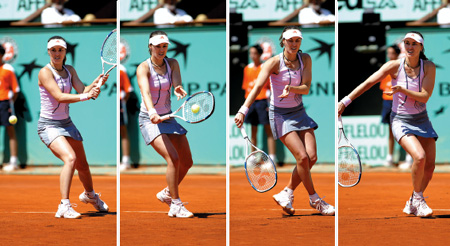
It’s a risky play, but great disguise, excellent footwork, and solid technique make Hingis’ drop shot a winner


In a game dominated by power hitters, Martina Hingis’ brand of control-oriented tennis makes her a fan favorite. A genius at geometry, the former world No. 1 uses the whole court to beat her opponents. Not only does she use angles and drives to move them side to side, but she also regularly throws in hard-to-read drop shots to get them running up and back. Here’s how she executes them.

1. Hingis has recognized that she has to hit a backhand, and her preparation has begun as it would for a backhand drive. There’s nothing at this point that would give her opponent a clue that she’s going to deliver a drop shot instead. Also, notice her location on the court. She’s right on top of the baseline and moving forward, which is ideal for the drop shot. You don’t want to try difficult finesse shots from deep behind the baseline.


2. Look at her feet. You can tell she’s using small, measured steps to put herself in position for the oncoming ball. Although Hingis may not be the fastest player on the tour, her footwork—the way she prepares with her feet for each shot—is among the best. As a result, her entire body, from her shoulders to her feet, is perfectly balanced. She appears to be using a semi-Western grip with her left hand and a Continental with her right, which is ideal for two-handed backhands.
3. We now see the first hint that Hingis won’t be driving the ball. Her hands are separating on the grip, indicating that either a slice or a drop shot is on the way. She uses her left hand to cradle the throat of the racquet and assist in the take-back. Also, because Hingis uses a Continental with her right hand on her two-hander, she doesn’t have to change her grip with that hand regardless of her shot selection. Her weight is loaded onto her back foot as she gets ready to step into the ball.
4. We can now tell that Hingis is committed to a drop shot, and not a slice, because her racquet is going higher but not much farther back. If she were planning to deliver a slice, the racquet would be more behind her. Note that Hingis’ body is facing the side of the court, something that players with two-handed backhands often fail to do. For a drop shot, let the ball come to your side more than you would for a drive.
5. Hingis’ weight has almost fully transferred onto her right leg as she continues to move into the ball. Again, look at her balance. The legs, hips, shoulders—everything is in the right position. Her hands are perfectly behind the ball and she’s measured exactly how she wants to address it. Her left hand is still cradling the throat of her racquet and her left palm is lined up with the racquet face, helping to guide it into position.


6. Hingis makes contact right in the middle of the string bed. Keeping your shoulders closed helps you swing through the ball, and players with one-handed slice backhands do that by letting their off hand move back and act as a counterbalance. Players with two-handers tend to push through with their off hand—as Hingis does here—and, as a result, have to make a special effort to stay turned.
7. After hitting the ball, Hingis continues to move through the shot and into the court. Her footwork is exemplary. She’s using what’s called a carioca step, which allows her to move forward while remaining sideways. If you look back, you can see her core has remained sideways since the second frame. Her focus is still on the contact point; her head has remained still, and she hasn’t looked up to follow the ball yet.
8. Hingis has started her recovery and has begun to look to the other side of the court to gauge the success of her drop shot. She’ll continue to move forward after striking the ball and will try to anticipate her opponent’s reply, if there is one, and take it out of the air if possible. She never assumes that her drop shot will be an outright winner. This is a great lesson for everybody.

Friday, November 03, 2006

Jump start Your Warm Up

We’ve all done it. We arrive at the court just minutes before our match starts, do a couple of knee bends, and then think we’re ready to play. After dropping the first three games of the set we scratch our heads, wondering why we’re playing so lifelessly. If you want to come out firing bullets instead of blanks, you’ve got to come on the court warm and ready to play.

A quick and effective way to do this is by jumping rope for several minutes. It:

Simulates running– Work the rope up to a good speed and you’ll be ready to sprint for a drop shot when the match starts.

Heats you up – Watch a professional in any sport and you’ll see they start a contest already sweating. For those worried about tiring out, a moderate amount of jump rope will actually energize, not weaken you.

Exercises your entire body – Jumping rope utilizes the wrist, forearm, shoulder, and whole leg, which are all crucial for playing good tennis. It also increases coordination and balance, two things a player can never have enough of.

Saturday, October 28, 2006

One Handed Backhand fix

Accelerating the RacquetProblem

You lack the power you’d like on your one-handed backhand, especially since you seem to swing with plenty of force. Many times this happens because your racquet is accelerating at the wrong time. Instead of speeding up into contact, you’re actually accelerating the racquet after impact. This can lead to an exaggerated and off-balance follow-through.

Solution

On your backswing, hold the upper throat of your racquet with your nondominant hand so the head is back by your hip and your hitting arm is away from your body. Don’t let go of the racquet until the forward swing snaps it out of your grasp. Think of creating all the power and racquet speed on your stroke from the snap out of the backswing to the point of contact. Make sure your nondominant arm and shoulder don’t rotate around with the start of your forward swing. They should work as a counterbalance, helping you resist the tendency to rotate open and providing more power for the front shoulder to pull and drive the stroke. You’ll find that your racquet is now accelerating up to full speed before contact rather than afterward. This will generate more leverage in your swing and make for a natural follow-through.

Snap the Racquet Forward

Sunday, October 22, 2006

Make the Most of Your Volleys

"Sensible technique and thoughtful strategy will turn you into a force at net."


Without question, the baseline is where today’s players conduct business. At every level, though, I still believe the easiest place to finish a point is at net. You pressure your opponents by taking time away and forcing them to pass you. Even if you’re a solid baseliner, it’s important to get to net occasionally to keep your opponent off-balance. And if you’re a frequent doubles player, solid net play is a must. Here’s how to make the volley a valuable part of your game.

BEGINNER


OBJECTIVE 1: Hold the racquet properly.

One of the most important aspects of volleying is holding the racquet so you have the same grip on both the forehand and backhand. I like to tell beginners to hold the racquet like they’re shaking hands with it. But there’s no perfect way to do it. Boris Becker used a grip that was more toward the forehand side, andPractice Keeping Your Short Swing Simple although it wasn’t textbook, it got the job done. Experiment with your grip to see what you find most comfortable for hitting volleys off either side.

OBJECTIVE 2: Keep your swings short and body composed.

When it comes to volleying, less is more. You want as little motion with your racquet and body as possible. Big swings and lots of movement lead to inconsistent results. Start with a stable base and turn your shoulders so that they’re as perpendicular to the net as possible. Your racquet should only go as far back as your shoulder turn takes it. To hit the volley, step forward and make contact out in front of you. Use a short, punching swing that’s no more than 1 to 2 feet long. The power on the volley comes from the step forward, the punch, and the pace from your opponent.


INTERMEDIATE

OBJECTIVE 1:Stay in control on tougher volleys.

The ball is going to be moving faster at this level, so you’ll be forced to cover more court. Still, you need to have control over your body. That’s why the best volleyers have great core strength (from the thighs toLearning to Hit Low Balls the midsection). This prevents them from bobbing up and down, particularly on low balls. You need to bend at your knees, not at the waist, and keep a stable upper body when hitting a low volley. Also, with the increased pace and movement of the ball, you may not have the opportunity to step into your volleys. Even so, try to get your shoulders perpendicular to the net before you swing.

OBJECTIVE 2: Use angles to finish points.

Approaching the net is an aggressive play that generally ends points quickly. The easiest way to hit a winner off a volley is to set it up first with a powerful ground stroke. Putting your opponent on the defensive will allow you to get closer to the net and give you opportunities to angle the next ball away from him. The closer you are to the net, the easier it will be to create a sharp angle. Rather than trying to volley deep into the open court, which can cause you to overhit, angle the ball away from your opponent—this forces him to cover more court. Just remember to catch the outside edge of the ball to produce an angle.


ADVANCED

OBJECTIVE 1: Pick the right moments to attack.

At this level, you need to be smart about how you construct your points at net. Make sure you hurt your opponent with an approach shot that opens up the court and then close in and cover the passing lanes. Once at net, you have to decide when to go for it. A ball around chest height is an invitation to finish theHitting a Drop Volley point. But shots from around the knees and below may call for more safety. In this case, open up your racquet face a little bit and do whatever you can to get the ball over the net and deep in the court. This will give you more time to recover and force your opponent to hit a longer passing shot. Going down the middle can be a great play in this situation; if you hit a defensive volley to one corner, you open up angles for your opponent to pass you.

OBJECTIVE 2: Use the drop volley.

The drop volley is an effective shot to use at net after you’ve driven your opponent behind the baseline. Open up the racquet face a little, soften your hand on the grip, and almost catch the ball on the strings. This helps you deflect your opponent’s shot gently over the net. The secret to a good drop volley is not how short you can hit it; it’s actually how far you can push your opponent back behind the baseline before you attempt it. By not having to hit so close to the net, you significantly increase your margin for error.

Wednesday, October 18, 2006

Bounce-hit to Stay Sharp

Whenever you stop playing for a while, or whenever your game goes into a slump, one of the first things to go is your timing. Strokes that felt natural and automatic start to feel like they've been replaced with awkward and forced imitations. And usually, the harder you try to fix the problem, the worse it becomes. But there's an easy solution that you can use any time you need to bring your timing and your strokes back into focus. It's called the “bounce-hit” drill.

Introduced by Timothy Gallwey in his classic book The Inner Game of Tennis, bounce-hit is deceptively simple, but it works like magic.

Here's how to do it:

Whenever the ball bounces, say "bounce" aloud to yourself. And whenever you or your opponent hits the ball, say "hit" aloud as well. This exercise works because it engages your mind enough to allow the more automatic, semi-conscious part of your brain to take over. That helps return your timing and your strokes to normal. And as a bonus, this drill works just as well when you're nervous or when you feel you're thinking too much on the court.